
Product · LibSyncComing soon

Your CAD library tidy on the server.

LibSync (Library Synchronizer) was designed with AutoCAD libraries in mind, but works for any folder — from project archives to a simple backup of your documents. Only what's new, changed or deleted goes across, with an automatic backup before every change and a safe orphan workflow.

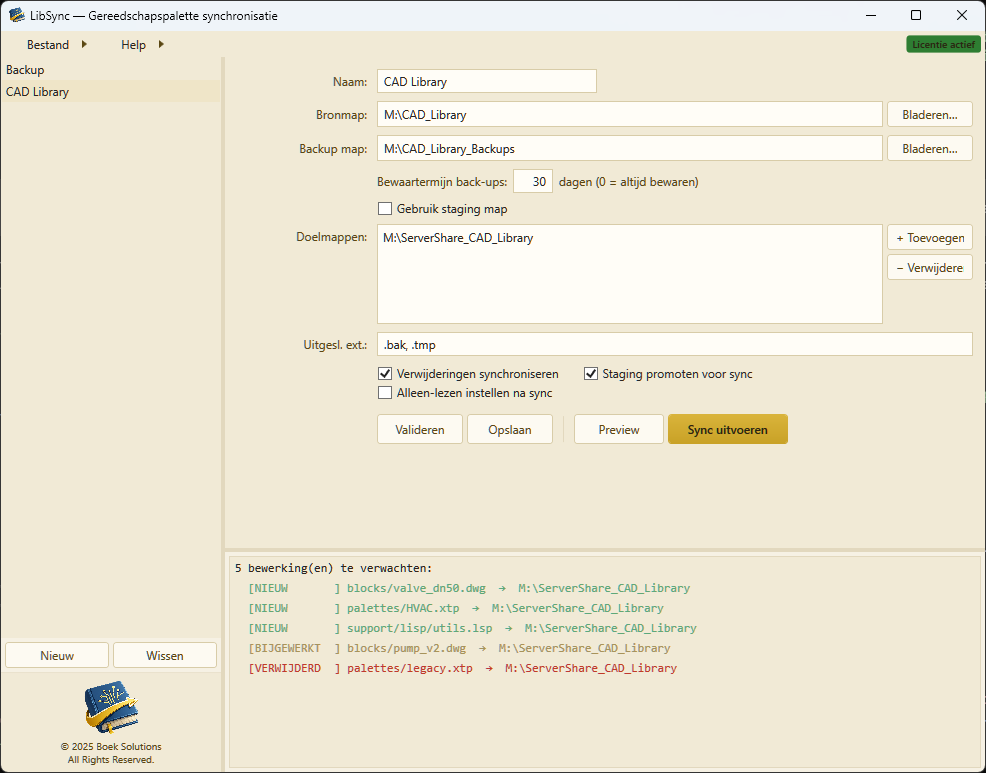
LibSync — hoofdvenster met synchronisatieprofiel, mappen en wijzigingsoverzicht.
Why LibSync

Library management without hassle

Only what changed

No more full copy-paste rounds. LibSync detects per file whether it's new, changed or deleted.

Tool palettes from AppData

Edit your tool palettes locally, stage them to your library, sync them to the server in one go.

Safe with orphans

Files left behind on the target side are shown separately — nothing is silently deleted.

Always a way back

Before LibSync overwrites or deletes a single file, it automatically creates a backup — kept separate per sync run. Something went wrong? Restore it through an explicit flow with a mandatory preview, never automatically.

Features

Practical and predictable

Smart diff

Compares source and target per file on time, size and content.

Sync profiles

Multiple source/target configurations side by side for library, palettes and projects.

Staging

From AppData to your local library, then to the network share.

Orphan dialog

Orphan files are shown separately with an explicit choice.

Non-destructive

No deletions without confirmation by default.

Network-share friendly

Efficient over slow or busy company shares.

Dark mode

Calm interface, even on long sync sessions.

8 languages

English interface plus seven other languages.

Typical workflow

From edit to company server in four steps

  1. Step 01
    Edit locally

    Work in your tool palettes or library on your own workstation.

  2. Step 02
    Stage to library

    From AppData to your central library folder — controlled.

  3. Step 03
    Scan & diff

    LibSync determines exactly which files are new, changed or orphan.

  4. Step 04
    Sync to server

    Confirm and the network share is up to date — no unnecessary transfer.

For what

Not just AutoCAD

LibSync is built for managing a company CAD library, but the engine is generic — any folder pair that must stay consistent fits.

AutoCAD library

Blocks, tool palettes, templates and support files to the company share.

Project archives

Move completed projects periodically to an archive drive.

Other software

Any tool with a local and central folder — Revit families, Inventor content, standards.

Everyday backups

Any folder that needs a regular copy — documents, project folders, photos — benefits from the same safe sync-and-backup engine.

Background

Why a CAD library drifts out of sync

Blocks, templates, tool palettes, standards and LISP routines live on a network share in most firms, but get edited locally. Without discipline you end up within months with a collection of versions and nobody knows which one leads. LibSync fixes that with an explicit, reviewable synchronisation instead of manual copy-and-paste.

Only the differences, not the whole folder

A full copy pass over a library of thousands of files costs time and rewrites timestamps on files that never changed. LibSync compares source and target per file and presents the result in four categories: new, changed, unchanged and orphan. Before synchronising you see exactly what will happen, including file count and total transfer size.

Bringing tool palettes out of AppData

AutoCAD stores tool palettes in your user profile under AppData — a folder that is rarely part of a backup or sync routine. LibSync stages those palettes into your library folder and carries them to the server in the same pass, so a palette one drafter improved does not stay stuck on a single workstation.

Orphans: deleting on purpose

Files that only exist on the target side are included in the normal sync deletions by default, after the usual confirm-with-counts step. Want to review them separately first? Turn off 'Synchronise deletions': LibSync then lists every orphan with its path and size, and you pick one action — skip, delete, copy back to source, or rename — applied to the whole list.

Profiles for recurring routes

Most firms sync the same paths over and over: library to server, standards to a project folder, palettes to a department share. Save those routes as profiles so a sync round becomes pick, scan, review, run. Not every folder has to come along either: filters keep temporary files and backup folders out of the comparison.

People also search for
  • sync AutoCAD library to server
  • share tool palettes over network
  • manage CAD standards
  • folder sync tool Windows network drive
  • AppData tool palette backup
  • block library management
FAQ

Questions about LibSync

Is LibSync only for AutoCAD libraries?

No. LibSync synchronises any folder to any other folder. The AutoCAD-specific features — such as staging tool palettes out of AppData — sit on top of a general folder sync.

Can I lose files by using LibSync?

No — that's the core design principle. Before LibSync overwrites or deletes a file, it automatically backs that file up. That backup can always be restored.

How does restore work?

Every sync run gets its own timestamped backup, with changed and deleted files kept separately. Restore lets you pick an earlier run, review a mandatory preview of what will be restored, and only then confirm — never automatically.

Does LibSync delete files on the server?

Yes — with 'Synchronise deletions' on (the default), files no longer in the source are removed automatically, after a confirm step showing counts. Turn that setting off and they're shown as orphans instead, with path and size, so you choose what happens to them.

Does it work with UNC paths and mapped drives?

Yes. Source and target can be a local folder, a mapped network drive or a UNC path, as long as your Windows account has rights on it.

Can I see what will happen before syncing?

Yes. The scan lists the status per file plus a summary with count and size. Nothing is written until you confirm.

Is a server component or cloud account required?

No. LibSync runs as a standalone Windows application on the workstation and uses only the network rights you already have.

When can I buy LibSync?

The application is finished and tested; sales start once the payment environment is live and the business registration is complete.

Status

Ready for release

LibSync is feature-complete and tested. Sales will start as soon as the payment environment leaves sandbox and business registration is complete.